Wednesday, 26 January 2005

Fortune Teller


Once the little lead toy balanced in the spoon melts, Austrian tradition dictates that you dump it into a bowl of water and read your fortune for the New Year in its shape.

Mine turned into a lumpy-looking rose…which we took to be in the same family as “Tree”, which (so the handbook said) means that my loved ones will demonstrate much loyalty in 2005. This reassuring fortune didn’t come as much of a surprise: there was a 2ft-high stack of cards waiting for me on my desk when I got back from Christmas holidays! Thank you so much for continuing to write and send treats despite my most embarrassing tendency to be late with replies… Um, on that note: please expect my Winter Cards to arrive in the mail sometime before March.

My phenomenal Christmas holiday was split between London, Bergamo and Vienna. Clare was generous enough to host me (in her gorgeous brand-spanking-new apartment) for a whirlwind 4-day visit, during which Briony kindly prepared a proper English luncheon, Anju and I spent far too much money shopping, and Dave B joined us for his first taste of homemade eggnog! It was lovely to see them all again, and though I was physically exhausted by the time I left, emotionally I felt like a juiced-up battery.

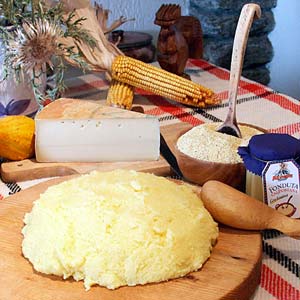
Having picked me up at the airport after London, Filippo's mom took me straight to meet a gaggle of aunties, uncles and cousins...and I spent the afternoon EATING, speaking slow and careful English and trying to figure out what the heck they were saying by transposing Italian to French. This was pretty much the theme of my vacation, actually. They were so welcoming and stoked to finally meet The Canadian; I got lots of beautiful Christmas presents and labour-intensive, individualized vegetarian meals –-including polenta taragna: oven-roasted polenta with a centre of secret cheese!!! Though most of his cousins spoke amazing English, the language barrier finally got to me on Boxing Day; following a temper tantrum, consensus was that I must learn Italian ASAP.

On December 30 we drove to Vienna and spent 4 days with some of Filippo's friends from university (he lived there for a year during his Econ. undergrad). As you can see by the photo above, new Year's Eve was a multicultural affair (Italians, Mexicans, Germans, Austrians) with unreasonable amounts of food and champagne.

Though I'm back to working mad hours and eating pocket lint for dinner, half my brain is devoted to the Job Hunt; Foreign Affairs Canada cuts the purse strings on March 18. Am calling on all my contacts and applying for every single vacancy that even vaguely suits my skill set... So far nothing is confirmed (am way too superstitious to name names), but I've had a few nibbles in Belgrade and desperately hope to stay. The only definite that's been offered is within a so-called "quiet diplomacy" peacebuilding project in Ottawa (similar to the mandate of the OSCE's High Commissioner on National Minorities) --despite being an amazingly interesting initiative, I'm not quite ready to go back to Canada or give up on the UN just yet, so will do my best to exhaust all other possibilities first.

The weather has been warm and mild until now, but looks like I'll have a White Birthday after all. Though the office cat normally wears the mascot hat, one of the drivers built someone special in celebration of yesterday's snowfall...

Meltable Mascot

Park across the street

Federal Parliament on Kralja Aleksandra

Tuesday, 25 January 2005

Soapbox

With many thanks to Amnesty International and BBC World


Displaced in Darfur

On this 60th anniversary of the liberation of Auschwitz, while dignitaries and Hollywood stars attend glitzy “Never Again”-themed banquets complete with Spielberg-inspired soundtracks, please allow me to highlight recent examples of genocide inflicted on millions of people whose skin isn’t white:

Sudan

Right now, pro-government Arab Janjaweed militias are accused of carrying out a campaign of ethnic cleansing against non-Arab groups in the region. Despite 21 years of conflicts, more than 2 million dead, 6 million forced to flee their homes, thousands of women and children abducted and/or raped, hundreds of villages destroyed and relatives still missing, not one perpetrator of war crimes or crimes against humanity is known to have been brought to justice in Sudan.

Tibet

Some 1.2 million Tibetans are estimated to have been killed by the Chinese since 1950. Tens of thousands of people continue to be detained or imprisoned in violation of their rights to freedom of expression and association, and are at serious risk of torture or ill-treatment. Thousands of people are sentenced to death or summarily executed for displaying photos of their spiritual leader, the Dalai Lama. Unarmed demonstrators were shot without warning by Chinese police on five occasions between 1987 and 1989.

Religious practice was forcibly suppressed until 1979, and up to 6,000 monasteries and shrines were destroyed. Gedhun Choekyi Nyima, the young boy recognised by the Dalai Lama as the reincarnation of the Panchen Lama, was abducted at the age of six by the Chinese Government in May 1995. A year later China chose and installed their own Panchen Lama.

Beijing has admitted a policy of deliberately encouraging Chinese to settle on a long-term basis in Tibet. Tibetan farms and grazing lands have been confiscated and incorporated into collectivised and communal farms. Chinese traders are favoured by lower tax assessments and the dominant position of Chinese in government administration. Chinese officials are paid various bonuses for working in Tibet.

Restrictions have increased on the cultural and religious rights of the mainly Muslim Uighur community in Xinjiang, where thousands of people have been detained or imprisoned for so-called "separatist" or "terrorist" offences. In Tibet and other ethnic Tibetan areas, freedom of expression and religion continue to be severely restricted. China continues to use the international "war against terrorism" as a pretext for cracking down on peaceful dissent.

Timor-Leste
(East Timor)

Timor-Leste's road to independence - achieved on 20 May 2002 - was long and traumatic. The people of the first new nation of the century suffered some of the worst atrocities of modern times. A quarter of the population is thought to have died during Indonesia's 25-year occupation which ended in 1999. Indonesia invaded shortly after Portugal withdrew in 1975 and forcefully tried to subdue a resentful people and guerrillas fighting for independence. World powers were accused of contributing to the subsequent calamity by turning a blind eye or by actively supporting the occupation by supplying weapons.

Five years ago, the population of Timor-Leste voted in a UN-organized ballot for independence from Indonesia. In the run-up to the ballot and immediately afterwards, the Indonesian security forces and Indonesia-backed militia groups opposed to independence embarked on a campaign of murder, destruction and intimidation. Around 1,400 people were killed, an unknown number tortured, and women were raped and subjected to other forms of sexual violence.

The violations were so wide-spread and systematic that they are considered to be crimes against humanity, and over 350 people have so far been indicted in a UN-backed justice process in Timor-Leste. Some 280 of them are believed to be at large in Indonesia. However, Indonesia has investigated just five cases and brought only 18 people to trial, and has failed to hold accountable a single member of the security forces for the human rights violations committed during this period.

Rwanda

Between April and July 1994, Rwanda was the site of a horrifying litany of human rights abuses: mass killings of unarmed civilians, rape and numerous other acts of torture. Between 800,000 and one million Rwandans were killed in the space of 100 days. Most of the dead were Tutsis, and most of those who perpetrated the violence were Hutus in the Rwandese Armed Forces (FAR) and their paramilitary allies.

The UN estimates that between 250,000 and 500,000 rapes were committed during the genocide. Degradation was integral to the physical violence, with some women being made to parade naked or perform various humiliating acts at the bidding of soldiers and militia. Compounding the trauma of being victims and witnesses of horrendous brutality, many women raped during 1994 now suffer the reality of living with sexually transmitted diseases including HIV/AIDS with little hope of legal recourse, medical care or compensation.

Cambodia

Between 1975-1979, the Khmer Rouge were responsible for more than 1.7 million deaths: killing at least 20,000 political prisoners, and torturing hundreds of thousands of people using the most horrific methods imaginable. Their victims included doctors, teachers, children, babies, students, priests, people who spoke a foreign language or wore glasses, the elderly and the sick.

Only now is the mechanism beginning to be put in place to bring those responsible for the "killing fields" to justice. Cambodia and the UN have agreed to set up a tribunal to try the surviving leaders of the genocide years; people who were implicated in involvement in serious human rights violations will finally be brought before a court.

Hundreds of people, particularly election candidates (and their supporters) who oppose the ruling Cambodian People’s Party (CPP), continue to be murdered every year.