Tuesday, 19 July 2005

Don't assume that I know what I'm doing.

As you may know, I am very superstitious. I am mocked for knocking on anything nearby (doesn't have to be wood) whenever I've said something iffy; not discussing hopes or plans unless they're 100% guaranteed to come true; placing bets with the Universe like "if my article comes out of the printer before this song is over, then my funding proposal will be approved". I am also a compulsive horoscope-checker and dream-analyst; that today's horoscope would mention dreams is particularly interesting, especially since I had a particularly interesting dream during the scant 27 minutes of sleep that I enjoyed last night.

Here it is, courtesy of Astrology.com:

When times are tough, or at least tricky, the Universe often sends hints our way, via coincidental circumstances, vivid or recurring dreams or the appearance or reappearance of someone whose presence makes us feel a certain way. It's up to you now to figure out what those coincidences and dreams are all about. You know you can do it. If anyone is an expert at unraveling such things for others, it's you. Do it for yourself now.

So, I dreamt that Moby and I were chatting on the phone (like the old friends that we are) then met up for drinks in a comfortable bar. It would've been neat to see more of what we talked about, but dad woke me up to tell me that it was time for him and mom to catch the airport bus. Anyway, it was super striking/realistic, and I was intrigued that Moby (of all people) was the guest star--why not River Phoenix or Ashton Kutcher?! (I'm sorry, I love him. I don't care what you say.) I've seen his quiet little Crib on German MTV (one of my two channels) and have a couple of his CDs here, but can't say that I'm particularly fixated on him/his work...but was discussing veganism with mom and dad yesterday (in regards to the class action lawsuit that the Physicians Committee for Responsible Medicine has filed against various dairy producers in the States) and Moby is maybe one of the most outspoken vegan celebrities out there...

So, was prepared to accept this as being the path of my frazzled brainwaves, until I checked out Moby's website at lunchtime, and came across this entry in his blog (below). I've been subjecting the poor Italian to "what am I going to do with my life?"-themed discussions lately, and thought that maybe Moby was trying to get a message through.

Steve Jobs

Jul 08, 2005 - New York City

someone forwarded this to me and i wanted to share it with you. it's steve jobs' commencement for this years graduating class at stanford.

-moby

Do What You Love: Time is Too Short to do Anything Else ...

"I am honored to be with you today at your commencement from one of the finest universities in the world. I never graduated from college. Truth be told, this is the closest I've ever gotten to a college graduation. Today I want to tell you three stories from my life. That's it. No big deal. Just three stories.

The First Story is About Connecting the Dots.

I dropped out of Reed College after the first 6 months, but then stayed around as a drop-in for another 18 months or so before I really quit. So why did I drop out?

It started before I was born. My biological mother was a young, unwed college graduate student, and she decided to put me up for adoption. She felt very strongly that I should be adopted by college graduates, so everything was all set for me to be adopted at birth by a lawyer and his wife.

Except that when I popped out they decided at the last minute that they really wanted a girl. So my parents, who were on a waiting list, got a call in the middle of the night asking: 'We have an unexpected baby boy; do you want him?' They said: 'Of course.' My biological mother later found out that my mother had never graduated from college and that my father had never graduated from high school. She refused to sign the final adoption papers. She only relented a few months later when my parents promised that I would someday go to college.

And 17 years later I did go to college. But I naively chose a college that was almost as expensive as Stanford, and all of my working-class parents' savings were being spent on my college tuition.

After six months, I couldn't see the value in it. I had no idea what I wanted to do with my life and no idea how college was going to help me figure it out. And here I was spending all of the money my parents had saved their entire life. So I decided to drop out and trust that it would all work out OK. It was pretty scary at the time, but looking back it was one of the best decisions I ever made. The minute I dropped out I could stop taking the required classes that didn't interest me, and begin dropping in on the ones that looked interesting.

It wasn't all romantic. I didn't have a dorm room, so I slept on the floor in friends' rooms, I returned coke bottles for the 5¢ deposits to buy food with, and I would walk the 7 miles across town every Sunday night to get one good meal a week at the Hare Krishna temple. I loved it. And much of what I stumbled into by following my curiosity and intuition turned out to be priceless later on. Let me give you one example:

Reed College at that time offered perhaps the best calligraphy instruction in the country. Throughout the campus every poster, every label on every drawer, was beautifully hand calligraphed.

Because I had dropped out and didn't have to take the normal classes, I decided to take a calligraphy class to learn how to do this. I learned about serif and san serif typefaces, about varying the amount of space between different letter combinations, about what makes great typography great. It was beautiful, historical, artistically subtle in a way that science can't capture, and I found it fascinating.

None of this had even a hope of any practical application in my life. But ten years later, when we were designing the first Macintosh computer, it all came back to me. And we designed it all into the Mac. It was the first computer with beautiful typography. If I had never dropped in on that single course in college, the Mac would have never had multiple typefaces or proportionally spaced fonts. And since Windows just copied the Mac, it's likely that no personal computer would have them.

If I had never dropped out, I would have never dropped in on this calligraphy class, and personal computers might not have the wonderful typography that they do. Of course it was impossible to connect the dots looking forward when I was in college. But it was very, very clear looking backwards ten years later.

Again, you can't connect the dots looking forward; you can only connect them looking backwards. So you have to trust that the dots will somehow connect in your future. You have to trust in something--your gut, destiny, life, karma, whatever. This approach has never let me down, and it has made all the difference in my life.

My Second Story is About Love and Loss.

I was lucky--I found what I loved to do early in life. Woz and I started Apple in my parents' garage when I was 20. We worked hard, and in 10 years Apple had grown from just the two of us in a garage into a $2 billion company with over 4000 employees. We had just released our finest creation--the Macintosh--a year earlier, and I had just turned 30.

And then I got fired.

How can you get fired from a company you started? Well, as Apple grew we hired someone who I thought was very talented to run the company with me, and for the first year or so things went well. But then our visions of the future began to diverge and eventually we had a falling out. When we did, our Board of Directors sided with him. So at 30 I was out. And very publicly out. What had been the focus of my entire adult life was gone, and it was devastating.

I really didn't know what to do for a few months. I felt that I had let the previous generation of entrepreneurs down--that I had dropped the baton as it was being passed to me.

I met with David Packard and Bob Noyce and tried to apologize for screwing up so badly. I was a very public failure, and I even thought about running away from the valley. But something slowly began to dawn on me--I still loved what I did. The turn of events at Apple had not changed that one bit. I had been rejected, but I was still in love. And so I decided to start over.

Fired From Apple

I didn't see it then, but it turned out that getting fired from Apple was the best thing that could have ever happened to me. The heaviness of being successful was replaced by the lightness of being a beginner again, less sure about everything. It freed me to enter one of the most creative periods of my life.

During the next five years, I started a company named NeXT, another company named Pixar, and fell in love with an amazing woman who would become my wife. Pixar went on to create the world's first computer animated feature film, Toy Story, and is now the most successful animation studio in the world. In a remarkable turn of events, Apple bought NeXT, I returned to Apple, and the technology we developed at NeXT is at the heart of Apple's current renaissance. And Laurene and I have a wonderful family together.

I'm pretty sure none of this would have happened if I hadn't been fired from Apple. It was awful-tasting medicine, but I guess the patient needed it.

Sometimes life hits you in the head with a brick. Don't lose faith. I'm convinced that the only thing that kept me going was that I loved what I did. You've got to find what you love. And that is as true for your work as it is for your lovers.

Your work is going to fill a large part of your life, and the only way to be truly satisfied is to do what you believe is great work. And the only way to do great work is to love what you do. If you haven't found it yet, keep looking. Don't settle. As with all matters of the heart, you'll know when you find it. And, like any great relationship, it just gets better and better as the years roll on. So keep looking until you find it. Don't settle.

My Third Story is About Death.

When I was 17, I read a quote that went something like: 'If you live each day as if it was your last, someday you'll most certainly be right.'

It made an impression on me, and since then, for the past 33 years, I have looked in the mirror every morning and asked myself: 'If today were the last day of my life, would I want to do what I am about to do today?' And whenever the answer has been 'No' for too many days in a row, I know I need to change something.

Remembering that I'll be dead soon is the most important tool I've ever encountered to help me make the big choices in life. Because almost everything--all external expectations, all pride, all fear of embarrassment or failure--these things just fall away in the face of death, leaving only what is truly important. Remembering that you are going to die is the best way I know to avoid the trap of thinking you have something to lose. You are already naked. There is no reason not to follow your heart.

Diagnosed With Cancer

About a year ago I was diagnosed with cancer.

I had a scan at 7:30 in the morning, and it clearly showed a tumor on my pancreas. I didn't even know what a pancreas was. The doctors told me this was almost certainly a type of cancer that is incurable, and that I should expect to live no longer than three to six months.

My doctor advised me to go home and get my affairs in order, which is doctor's code for prepare to die. It means to try to tell your kids everything you thought you'd have the next 10 years to tell them in just a few months. It means to make sure everything is buttoned up so that it will be as easy as possible for your family. It means to say your goodbyes.

I lived with that diagnosis all day. Later that evening I had a biopsy, where they stuck an endoscope down my throat, through my stomach and into my intestines, put a needle into my pancreas and got a few cells from the tumor. I was sedated, but my wife, who was there, told me that when they viewed the cells under a microscope the doctors started crying because it turned out to be a very rare form of pancreatic cancer that is curable with surgery.

I had the surgery and I'm fine now.

This was the closest I've been to facing death, and I hope it's the closest I get for a few more decades. Having lived through it, I can now say this to you with a bit more certainty than when death was a useful but purely intellectual concept:

No one wants to die. Even people who want to go to heaven don't want to die to get there. And yet death is the destination we all share. No one has ever escaped it.

And that is as it should be, because Death is very likely the single best invention of Life. It is Life's change agent. It clears out the old to make way for the new. Right now the new is you, but someday not too long from now, you will gradually become the old and be cleared away. Sorry to be so dramatic, but it is quite true.

Your time is limited, so don't waste it living someone else's life. Don't be trapped by dogma--which is living with the results of other people's thinking. Don't let the noise of other's opinions drown out your own inner voice. And most important, have the courage to follow your heart and intuition. They somehow already know what you truly want to become. Everything else is secondary.

When I was young, there was an amazing publication called The Whole Earth Catalog, which was one of the bibles of my generation. It was created by a fellow named Stewart Brand not far from here in Menlo Park, and he brought it to life with his poetic touch.

This was in the late 1960s, before personal computers and desktop publishing, so it was all made with typewriters, scissors, and Polaroid cameras. It was sort of like Google in paperback form, 35 years before Google came along: it was idealistic, and overflowing with neat tools and great notions.

Stewart and his team put out several issues of The Whole Earth Catalog, and then when it had run its course, they put out a final issue.

It was the mid-1970s, and I was your age. On the back cover of their final issue was a photograph of an early morning country road, the kind you might find yourself hitchhiking on if you were so adventurous. Beneath it were the words: 'Stay Hungry. Stay Foolish.' It was their farewell message as they signed off. Stay Hungry. Stay Foolish. And I have always wished that for myself. And now, as you graduate to begin anew, I wish that for you.

Stay Hungry. Stay Foolish.

Thank you all very much."

The Stanford (University) Report June 14, 2005

Felling of a Warrior


Twenty years ago this week, the Rainbow Warrior was sunk by French agents in Auckland harbour. Paul Brown, who had sailed with the Greenpeace flagship just days earlier, recalls the worldwide shock at a callous act of state-sponsored terrorism - and asks why so many questions remain unanswered.

Friday July 15, 2005
The Guardian

Driving past Hampstead Heath pond to chase an interview the car radio was tuned in to the 2pm news. All was as it should be for any news reporter just back from a foreign assignment and keeping up with events. The first item, tagged "news just in", made me listen a bit more closely. The shock of the words that followed made me swerve, then swing the car round in a U-turn, and head straight back to the office.

The report said, "Greenpeace environment group's flagship the Rainbow Warrior has been sunk in Auckland, New Zealand following explosions. Early reports say crew members are missing but there are no more details."

The faces of those crew members flashed before me immediately. A few days before, 12,000 miles away, I had been laughing, drinking with and hugging this crew of eight nationalities as I left the ship after a month's hard labour and fun. My cabin partner had been Fernando Pereira, a Portuguese photographer. We had some good times together; I had attended his 35th birthday party on board just before I left.

The 11 crew had taken on Greenpeace's most ambitious campaign in its history, moving a contaminated people to a safe haven. The Americans, whose 1956 Bravo bomb had covered the people of Rongelap island in radiation, had removed all the population's thyroid glands to prevent cancer killing them and were using them as guinea pigs to see what further effect continued radiation had on their health. An increasing proportion of children were being born deformed. The island's elders appealed to Greenpeace for help, and I had signed on as a deckhand for a month to report the evacuation for the Guardian.

The next stage of the trip was for the Rainbow Warrior to sail to Auckland for supplies and then head a peace flotilla into the French nuclear test zone at Mururoa in the South Pacific. The Greenpeace crew, having seen the long-term effects of previous nuclear testing on innocent bystanders, was determined to do its best to disrupt the French programme.

In the shock of the news of the sinking all these memories and thoughts swirled through my mind. My job was to write the story, the facts as known, but there were not too many of those. This was July 11 1985, before mobile phones. New Zealand was still a long way away. In Auckland it was the middle of the night and every telephone line to Greenpeace's New Zealand office was jammed.

But by first edition I was able to report that all members of the crew had been accounted for but one - the body of Fernando Pereira had been found by navy frogmen. He had been trapped in his cabin by a second explosion as he went to retrieve his precious cameras.

The headline assigned to my piece was the first inkling of a longer-running and more disturbing story. It said: "Saboteurs sink Greenpeace campaign ship." At first the Auckland police were not sure what had caused the explosions. To them, sabotage seemed "the most likely explanation", but in an old ship with what they regarded as a bunch of amateur crew members, accident or stupidity were just as plausible.

Davey Edwards, the Rainbow Warrior's Yorkshire-born chief engineer, also had doubts "I was desperate for the first 24 hours because I thought it must be my fault. The explosion had come from the engine room, my responsibility. I kept racking my brains about what could have caused it, there were banks of batteries that could have caused a spark but nothing explosive."
But the following day an inspection of the hull by divers meant that an accident could be ruled out. The very substantial riveted plates of the converted Aberdeen-built trawler had had huge holes torn in them, but the jagged pieces of metal that remained were all bent inwards. The divers said limpet mines had been attached to the outside of the hull.

"It may sound strange but when we were told the explosion had come from outside, it was sabotage, or terrorism, it came as a relief," said Edwards.

It is hard to understand now that what came as a relief to Edwards came as an extraordinary shock to the rest of the world, and particularly New Zealand, which had never seen a bomb explode in anger on its territory, let alone an act of terrorism. Neither has there been one since, the event remaining deeply scored on the nation's psyche.

The puzzle for the police was who could be responsible for this murderous act against a peace group, their whole ethos based on the Quaker principle of non-violent direct action, of bearing witness to moral wrongs.

In my mind, and for the crew, suspicion naturally fell on someone French; after all, they were next in line for a protest. They also had a long history of violence against Greenpeace, albeit confined to boardings vessels, using tear gas and beating crew members with truncheons. Yet an act of terrorism by the French state on the soil of a friendly power, clearly designed to kill, was still unthinkable.


Twenty years on it seems just as strange. State terrorism is something the United States and the United Kingdom are prepared to go to war over. It is something carried out by rogue states, members of the "Axis of Evil". Members of the European Union somehow do not fit the description.

But by day two of the Rainbow Warrior inquiry Auckland police were looking for French people. One had visited the ship hours before the explosion when, during an open day for the Auckland public, one unknown Frenchman had spent time looking round the crew quarters.

Within hours information was flooding into the police from all over the North Island of events involving French nationals, sightings of yachts, strange landings of equipment, movements of camper vans and rendezvous in obscure places. In a country where the population is tiny, strangers a curiosity, and French tourists rare, the sighting of so many French people seemed a remarkable coincidence. Five days later a French "honeymoon" couple, Alain Jacques Turenge and his wife Sophie Turenge, were arrested. Inquiries revealed they were French secret agents Major Alain Mafart, aged 35, and Captain Dominique Prieur, aged 36. They were first charged with passport offences then arson and murder.

The information pouring in from all over New Zealand, the Pacific and even England built up a picture of an extensive French secret service operation to cripple the Rainbow Warrior. But it was too late to catch the perpetrators. Even though detectives interviewed four Frenchmen in the Australian territory of Norfolk Island after the attack they had not got enough evidence to hold them and the Australian government insisted the New Zealanders leave.

These four agents disappeared on a yacht which was never seen again. The official police report says officers believe the Ouvea was scuttled when the men were picked up and returned to France in a nuclear submarine.

In the time leading up to the trial of the two agents in custody French journalists continued to press President Mitterand for who had sanctioned the operation. On August 27 he issued a report which fully exonerated the French secret service. It was not credible, and when a request by New Zealand for the extradition of the crew of the Ouvea was refused it was clear this was a cover-up at top level.

By September 22 the game was up. Prime Minister Laurent Fabius admitted that the French secret service had ordered the attack on the Rainbow Warrior and the French defence minister Charles Hernu, a close ally and friend of Mitterrand, resigned, accepting responsibility and saying the president was not involved. We know now that this was not the full truth either: a recent confession by the former head of the Secret Service claims that Mitterand did, in fact, sanction the attack after all.

Astonishingly no government outside New Zealand condemned the French action, least of all Britain, despite the fact it was a British vessel.

The role and attitude of the French state remains murky. Marfart and Prieur, who clearly did not plant the bombs themselves, had their charges reduced to manslaughter and were sentenced to 10 years. The French government was horrified and leaned heavily on New Zealand, even threatening trade sanctions, and barring lamb imports to the European Union. Within three years the UN had brokered a deal between the two countries. The French would formally apologise, and pay $13m in compensation to the New Zealand government. They also paid a further $8m to Greenpeace, which was already suing them in the Paris courts for compensation.

As part of the deal the convicted agents were transferred to French territory to complete their sentences. Within months they were freed to a heroes' welcome in Paris.

Greenpeace could not repair the original Rainbow Warrior and it was towed out to sea off North Island to be sunk again as a reef for sea life. The organisation used the money paid in compensation to launch the new Rainbow Warrior, a flagship larger, better equipped, and because of the French action, recognised worldwide. What happened in Auckland made Greenpeace a multinational in its own right.

The new Rainbow Warrior went back, and back again to Mururoa, and in 1996 was again the subject of an attack by the French military when it was boarded, the crew tear-gassed and equipment smashed. This time, as a journalist covering the event, I was arrested on the high seas, briefly imprisoned and interrogated on Mururoa itself while the tests continued. The worldwide protests finally led to the French abandoning nuclear testing in the Pacific.


Greenpeace Forest Crimes Unit surrounds Canadian Kimberly Clark Headquarters -Kleenex manufacturer targeted for destroying Canada's Boreal forest.

This year I travelled to New Zealand for an anniversary party. It was clear that among the celebrations of meeting old friends and happy past times there was still some anger.

Edwards, who now runs a fish restaurant in the Bay of Islands, which ironically was once a meeting place for the four French frogmen, summed up his current view: "The response, or rather non response, of the British government was a disgrace. Up to that moment I had always been proud to be British, but this was a British flagged vessel with a British citizen in desperate need of help and I heard nothing. Everything I had was sunk with the Warrior, but there was no offer of help, not even a new passport."

The Guardian applied in April under the Freedom of Information Act to try and find out what the British government knew about the attack and when, to perhaps give a clue as to why in 1985 state terrorism against British ships was acceptable. So far Downing Street has refused to answer although the Foreign Office has said it will do so soon.

Thursday, 7 July 2005

10 Year Anniversary

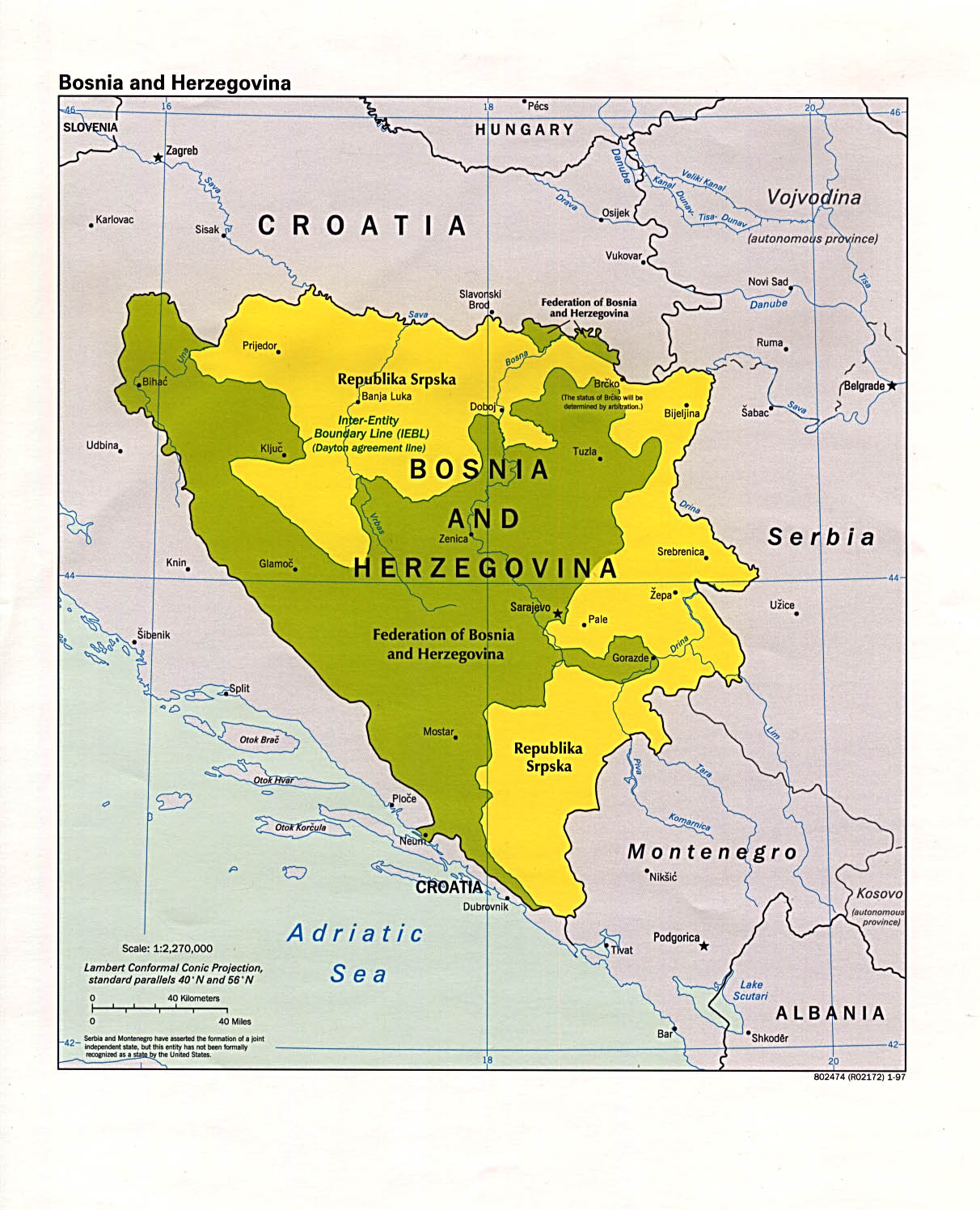
Aleksandar Karadzic (son of indicted former Bosnian Serb leader Radovan Karadzic) was arrested today about a week after his dad was reported as being in hiding in Montenegro, with the official statement being that Aleksandar "may have information vital to the goal of locating indicted war criminals or identifying their supporters". Normally, I'd be the first person screaming conspiracy theory at everyone, but in this case, I actually believe that NATO might be on the right track for once: it is commonly accepted that many 'missing' Hague indictees are living comfortably in Serbia and Montenegro, protected not only by their friends but by the 50% of this country's citizens who don't believe that the Srebrenica massacre took place.

In case you're a little fuzzy on details, allow me to recap the events for you, a few days shy of the 10-year anniversary.

Timeline: Siege of Srebrenica

In the summer of 1995, two years after being designated a United Nations Safe Area, the Bosnian town of Srebrenica became the scene of the worst massacre in the Bosnian war.

This is an account of the critical days leading up to the killings.

6 - 8 July 1995: Bosnian Serb forces had laid siege to the Srebrenica enclave, where tens of thousands of civilians had taken refuge from earlier Serb offensives in north-eastern Bosnia.

They were under the protection of about 600 lightly armed Dutch infantry forces. Fuel was running out and no fresh food had been brought into the enclave since May.

Serb forces began shelling Srebrenica. Bosnian Muslim fighters in the town asked for the return of weapons they had surrendered to the peacekeepers but their request was refused.

The Dutch commander called UN Headquarters in Sarajevo asking for "close air support" after shells and rockets landed close to refugee centres and observation posts manned by peacekeepers.

9 July 1995: The Bosnian Serbs stepped up their shelling and thousands of refugees fled to the town from southern camps ahead of advancing Serbs, who attacked Dutch observation posts, taking about 30 soldiers hostage.

One peacekeeper was fatally wounded when Bosnian Muslims fired on retreating Dutch troops.

10 July 1995: Dutch Commander Colonel Karremans filed a request for UN air support after the Bosnian Serbs shelled Dutch positions. UN Commander General Janvier initially refused, but agreed after another request from the colonel. Serb attacks stopped before the planes arrived and strikes were postponed.

Some 4,000 refugees were in the town by the evening and there was panic on the streets. Large crowds were gathered around the Dutch positions.

The Dutch commander told town leaders that Nato planes would launch massive air attacks against the Serbs if they had not withdrawn from the safe area by 0600 the following morning.

11 July 1995: The Serb forces did not withdraw, but at 0900 Colonel Karremans received word from Sarajevo that his request for close air support had been submitted on the wrong form. At 1030, the re-submitted request reached General Janvier, but Nato planes had to return to base in Italy to refuel after being airborne since 0600. By midday, more than 20,000 refugees - mostly women, children and the infirm - fled to the main Dutch base at Potocari.

At 1430, two Dutch F-16 fighters dropped two bombs on Serb positions surrounding Srebrenica. The Serbs responded with a threat to kill their Dutch hostages and shell refugees, causing the suspension of further strikes.

The Bosnian Serb commander Ratko Mladic (pictured on right, best buddy of poppa Karadzic) entered Srebrenica two hours later, accompanied by Serb camera crews. In the evening, General Mladic summoned Colonel Karremans to a meeting at which he delivered an ultimatum that the Muslims must hand over their weapons to guarantee their lives.

12 July 1995: Buses arrived to take women and children to Muslim territory, while the Serbs begin separating out all men from age 12 to 77 for "interrogation for suspected war crimes".

It is estimated that 23,000 women and children were deported in the next 30 hours. Hundreds of men were held in trucks and warehouses.

About 15,000 Bosnian Muslim fighters had attempted to escape from Srebrenica overnight and were shelled as they fled through the mountains.

13 July 1995: The first killings of unarmed Muslims took place in a warehouse in the nearby village of Kravica.

Peacekeepers handed over about 5,000 Muslims who had been sheltering at the Dutch base at Potocari. In return, the Bosnian Serbs released 14 Dutch peacekeepers who had been held at the Nova Kasaba base.

16 July 1995: Early reports of massacres emerged as the first survivors of the long march from Srebrenica began to arrive in Muslim-held territory.

Following negotiations between the UN and the Bosnian Serbs, the Dutch were at last permitted to leave Srebrenica, leaving behind weapons, food and medical supplies.

In the five days after Bosnian Serb forces overran Srebrenica, more than 7,000 Muslim men are thought to have been killed.